8. FAQ
Is this customs advice? No. DutyLookout produces estimates to work from. You remain responsible for what you declare. For high-value, regulated, or unusual goods, use a licensed customs broker — and give them this app's output as a starting point rather than a conclusion.
Which countries does it cover? Classification produces an internationally harmonised six-digit code plus the US-specific ten-digit line. Duty estimates are US import duty only. The HS6 portion is useful anywhere; the rate is not.
Will it overwrite HS codes I already have? No. Your own code is checked first, before the cache and before any AI call. A full ten-digit code that exists in the current schedule is kept and marked Merchant code. One that does not check out — retired, mistyped, or shorter than ten digits — goes to Needs review with the reason, so you decide what replaces it. DutyLookout only writes a code you approved, or one that cleared the auto-approve threshold if you turned that on, and the write-back step refuses outright to overwrite a code you entered or overrode.
Can it give me a code that does not exist? No. Every ten-digit code is validated against the published revision when the code is produced, and again at write-back time, immediately before it is written to Shopify — so a line retired between suggestion and approval is not written to your store. A code that is not in that revision is refused rather than displayed. That is a guarantee the code exists — not that it is the right code for your goods, which is why you still review it.
How does it decide the last four digits? With a second pass. The first pass reads your product text and settles the heading and subheading; a separate pass then reads the real ten-digit statistical lines published under that subheading and picks one of them. It does not write the suffix from memory. This is the check that catches the awkward case where the first pass gets the subheading right and the line wrong — a wrong line is still a real code, so nothing else would catch it. See How classification works.
How much does the AI cost me? Nothing beyond the per-classification price — there is no separate AI charge and no monthly fee. Products are classified in batches rather than one call each, results are cached across stores, and unchanged products are never re-classified, which is what keeps the per-classification price where it is.
Do other merchants see my products? No. The shared cache is keyed by a one-way hash of product text — matching without exposing. No shop identifier is ever stored on a cache entry.
Is there a trial? What happens when it ends? There is no trial, because there is nothing recurring to trial. The plan is $0/month and your first 25 classifications each 30-day billing period are free, so you can use DutyLookout indefinitely without paying if your needs are small. Nothing expires.
Will I be charged twice for the same product? No. A product is billed when it is added, or when its title, description, type, vendor, tags or materials change — never for an unchanged product. Re-syncing, re-opening the app, browsing and approving codes cost nothing, and identical content already classified for another store is served from cache and not billed.
What if my catalogue is bigger than 5,000 SKUs? No problem, and nothing to arrange. There is no catalogue limit, and everything past 5,000 classifications in a 30-day billing period is billed at the $0.032 floor rate.
How do I stop being charged? Uninstall the app. Because nothing recurs, that is all there is to it — usage you already ran in the current billing period is still billed by Shopify, and your existing codes stay in Shopify because they were written to your products, not held hostage in the app.
Can I re-run a classification? Yes. Edit the product — any change to title, description, type, vendor, tags or materials re-queues it (and bills it again). Sync catalog re-imports everything.
Why is one product 95% and a nearly identical one 85%? Confidence reflects how strongly that product's data supports the code. The 95% one probably has a description naming its materials; the 85% one is being classified from its title and type.
Does it handle variants? Classification is per product, not per variant. Products whose variants would classify differently — a set sold in both leather and canvas — should be split, or reviewed manually.
Can I try it before installing? Yes. There is a free HS-code lookup at dutylookout.com/lookup — no account, a few lookups a day while the daily allowance lasts. Describe a product in plain English and you get a suggested code with the reasoning behind it.
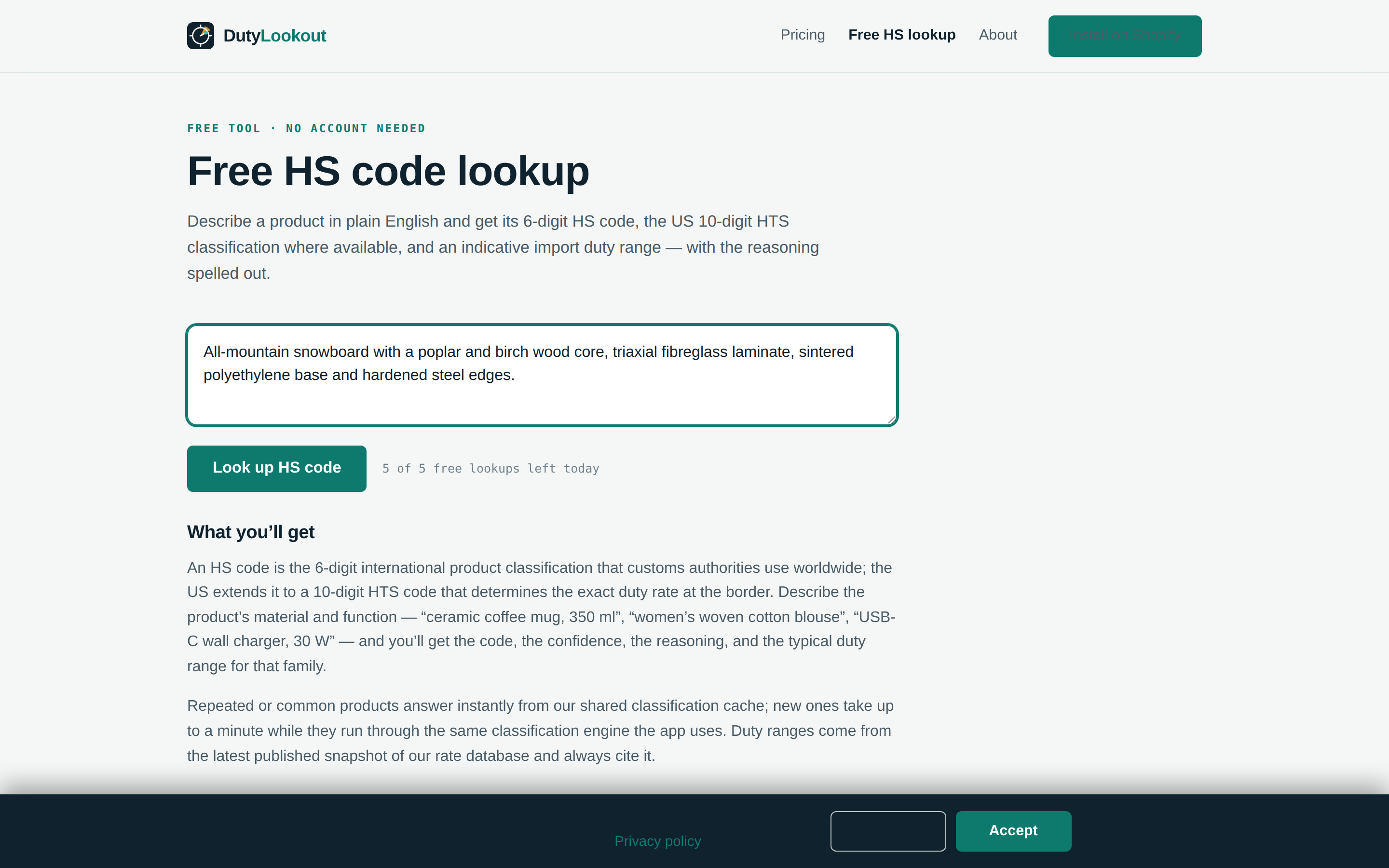
It uses the same tariff data and the same reasoning format as the app, so it is a fair preview of what you get — but it is not literally the same model. The free tool runs on Claude Haiku 4.5; your catalogue is classified with Claude Sonnet 5. Describe material and function, not brand — "stainless steel insulated water bottle, 750 ml", not "the Voyager".
Why did the free lookup say it was out of resources? Because it was. The free tool has two limits, and it will tell you which one you hit rather than fail silently:
- Per visitor — a handful of lookups a day from any one network, so one person cannot drain the tool for everyone.
- Everyone together — a fixed daily allowance for the whole tool, measured in AI usage rather than in a number of lookups, because a long, detailed description costs more to classify than a short one. When that allowance is spent the page says so plainly: the free lookup has used up its resources for today.
Either way the allowance resets at 00:00 UTC. This is a free, anonymous tool with no revenue behind it, so it is deliberately capped — installing the app is what removes the ceiling.
Is my data used to train models? No.